
Revelation Decoder: Mountains, Islands, Earthquakes
Discover a biblical understanding of these terms, what their symbolic understanding is, and whether it should be interpreted literally or non-literally in Revelation
ESCHATOLOGY
3/21/202610 min read
I searched the Bible for the uses of these words to have a symbolic understanding of them in case that is how it is interpreted in the book of Revelation. I also searched for words that were various forms of “earthquake.” I also do my best to answer when these earthquakes happen, if they are mutually exclusive, and if we interpret some of the elements literally or non-literally.
Mountains:
In Jeremiah 51:25, God refers to Babylon as the “destroying mountain, who destroys the whole earth.” In Ezekiel 6:2-3, God speaks against mountains as if they were people and pronounces judgement upon them. These personified mountains represent the idolatrous false worship of mountain shrines and Israel’s arrogance against God. The mountains represented all the people of Israel because that’s where their land was located, in the mountains. God was telling them that their high places would be torn down. In Ezekiel 38:20 about the future prophecy of Gog coming against Israel, it says that the mountains will be thrown down. This could mean literally by an earthquake, or it may have some symbolic meaning. Symbolically, it could mean that Gog as a lofty mountain that raises itself up against God and God’s people, that Gog would be destroyed. Perhaps it means both, but I favor the literal meaning, considering the other natural disasters that are mentioned in the context. In Daniel 2:35 in the interpretation of Nebuchadnezzar’s dream, the statue representing the kingdoms of the earth was destroyed by a stone which represented Christ’s kingdom, and that stone became “a great mountain and filled the whole earth.” In this context, the mountain represents a very great and powerful kingdom towering over all others.
Islands:
Isaiah 11:11; 40:15; 42:10; 49:1 personifies islands as the people and nations of the earth, the coastlands, and all that is at the end of the main continents or past them. Symbolically, the coastlands represent the Gentile world.
Earthquake / Quake / Shake / Tremble:
Earthquakes, lightning, and thunder are observed to have happened in the presence of God like on Mt. Sinai (Ex 19:13-19; 20:18; Judges 5:5; Isa 64:1-3). These things are also used as a form of distributing God’s punishment (Isa 29:6; Ezek 38:19).
In the future prophecy about Gog rising up against Israel, there will be a great earthquake in Israel because of God’s wrath, and everything will shake from the presence of the Lord (Ezek 38:19-20).
A prophecy about the coming Day of the Lord says that the earth will tremble and people will hide themselves under the rocks from the presence of the Lord (Isa 2).
Earthquakes are associated with God’s anger (2 Sam 22:8; Ps 18:7; 60:1-2; Jer 10:10).
The earth quaking is metaphorically associated with turmoil (Prov 30:21-23; Isa 54:10).
The earth quakes as the result of an army with horses causing the ground to tremble (Jer 8:16). In this way, the earth quaking is associated with people everywhere trembling with fear (Jer 49:21; 51:29; Ezek 29:7; 31:16; Amos 8:8). The earth quaking/shaking may or may not be literal (1 Sam 14:15; Job 9:6; Isa 13:13; 24:18-20). It is often symbolic language (Ps 82:5; 99:1; Jer 50:46; Ezek 26:15; Amos 9:1; Hag 2:6-7, 21-22).
In a prophetic foreshadow of the king of Babylon, he is said to have made the earth tremble and shake kingdoms, metaphorically (Isa 14:16). The earth is in reference to the people who dwell on the earth.
In the New Testament:
When Jesus died on the cross, there was a great earthquake (Mt 27:51, 54). An earthquake also happened when the tombstone of Jesus was rolled away by an angel (Mt 28:2).
Hebrews 12:26 says that God’s voice “shook the earth” and there is a future promise, “Yet once more I will shake not only the earth, but also the heaven.” This is to remove everything that is shakable so that only the unshakable may remain (i.e. the kingdom of God that will endure forever and ever).
Jesus warns that in the later days as part of the birth pangs of the earth, there will be earthquakes (Mt 24:7-8; Ro 8:22).
After the tribulation and after the signs in the sky, “the powers of the heavens will be shaken” (Mt 24:29), “the powers that are in the heavens will be shaken” (Mk 13:25).
Luke 21:25-28
“There will be signs in sun and moon and stars, and on the earth dismay among nations, in perplexity at the roaring of the sea and the waves, men fainting from fear and the expectation of the things which are coming upon the world; for the powers of the heavens will be shaken. Then they will see the Son of Man coming in a cloud with power and great glory. But when these things begin to take place, straighten up and lift up your heads, because your redemption is drawing near.”
Revelation Analysis:
Examining all this information, you will have to decide if the earthquakes spoken of in Revelation are literal or symbolic, or perhaps even both…
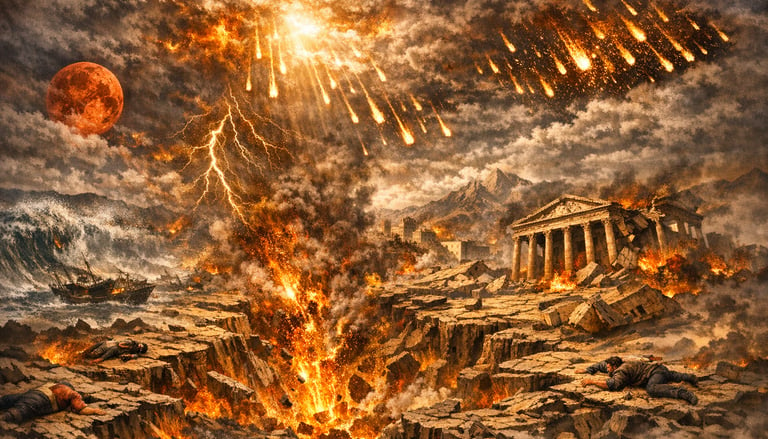
In the seventh bowl of wrath, Revelation 16:18 says that there was “a great earthquake,” greater than any earthquake that has ever happened on the earth. The earthquake split the great city (Babylon) into three parts, and the other cities of the nations fell because of it. Islands and mountains were affected as well, which could indicate tsunamis covering the islands, and mountains collapsing because of the earthquake. Extremely large hailstones also accompanied this. I wonder how a Preterist or Amillennialist would explain this passage? Like, how could this have already occurred in past history like 70AD? Has the world’s greatest earthquake already come and gone?
What we can ascertain from Revelation 16:18 is that since this earthquake coincides with the fall of Babylon, then we can connect it to those other passages in Revelation that speak about Babylon’s destruction (Rev 17-18). Meanwhile Revelation 14:8 may just be speaking a judgement against Babylon as if it already happened even though it has not. It’s like saying, “you’re toast” before you’re actually toasted and roasted. It’s called a premonition.
In the sixth seal, there is also an earthquake that happens (Rev 6:12). This happens before the seventh bowl of wrath earthquake (that bowl is during the seventh seal). Therefore, these two earthquakes are not the same earthquakes. The latter one is apparently much worse. However, both of them say that “every mountain and island were moved out of their places.” So, this apparently happens twice. But how can that be? Perhaps this language is hyperbole. Or maybe the mountains in this case are symbolic for empires and all forms of government and authority coming to an end because Jesus is taking back the earth. And then the islands could represent the far-off lands, the remote lands, and the Gentile peoples.
In the seventh seal and within the first four trumpets, Revelation 8:5 says, “Then the angel took the censer and filled it with the fire of the altar, and threw it to the earth; and there followed peals of thunder and sounds and flashes of lightning and an earthquake.” I do not take these signs to be necessarily anything more than illustrating the presence of God, as the vision is of what is happening in heaven. However, the signs will likely occur on the earth as well. But I would not cross-reference it with the other earthquakes to try and fit it in somewhere. Also, I take the following disasters to be evidentially literal, except for maybe the blood or wormwood. I don’t know what to think about that. Blood probably just means red. Wormwood could be an asteroid or a nuclear missile. The fire mountain thrown into the sea sounds like a volcano. And with volcanoes and nuclear missiles, at least part of the earth would be covered with atmospheric gases to block out the sun, moon, and stars.
When the seventh trumpet was blown, it says: “And the temple of God which is in heaven was opened; and the ark of His covenant appeared in His temple, and there were flashes of lightning and sounds and peals of thunder and an earthquake and a great hailstorm” (Rev 11:19).
I again take this to be the presence of God being illustrated which magnifies His power. The other times hail is mentioned is in Revelation 8:7 where the first trumpet is blown. But since Revelation 11:19 is the seventh trumpet, these are mutually exclusive and separate events. The only other time hail is mentioned is in Revelation 16:21 which speaks of the one-hundred-pound hailstones. This occurs during the seventh bowl of wrath, so that is also not the same event as 11:19. There are, therefore, three separate occasions when hail comes down. They are: the seventh seal and first trumpet (8:7), the seventh trumpet (11:19), and the seventh bowl of wrath (16:21).
An earthquake happens at the sixth seal (6:12). An earthquake precedes the first trumpet and comes after the seventh seal is broken (8:5). An earthquake happens at the seventh trumpet (11:19). One happens at the seventh bowl (16:18). All of them are mutually exclusive events like the hail.
Addendum
Continue reading if you would like to see my thought process and biblical study method for digging into more information. You may also learn a few things along the way, but in the end, I don’t get that much closer to finding out the occurrence of the Jerusalem earthquake.
Finding out the timing and occurrence of the last earthquake in 11:13:
The context of the other earthquake is that it is after the two witnesses are killed in Jerusalem (11:8). It is the beast that comes up out of the abyss that makes war with them and kills them (11:7). They then come back to life and ascend into heaven, then a great earthquake happens so that “a tenth of the city fell; seven thousand people were killed in the earthquake” (11:13). This is the second woe (11:14), and possibly after the sixth trumpet (9:13) and before the seventh trumpet (11:15). However, I am not convinced about the reliability of the chronological order here considering that the vision of the two witnesses was just randomly placed in there. For this reason, we need to take the information we have collected to find out more.
Exploring Woe:
Each woe is a trumpet blast. There are three woes after the fourth trumpet is sounded (8:12-13). There is a total of seven trumpets. However, “the first woe” is not concurrent with the first trumpet (9:12). The second woe is either the earthquake at the two witnesses or it is the sixth trumpet, but the third woe is the seventh trumpet (11:14). Two woes are repeated for the destruction of Babylon (18:10, 16, 19). So, if two woes are repeated for the destruction of Babylon and the third woe is said to be the seventh trumpet, this likely means that the earthquake happens in the destruction of Babylon. However, that does not make sense since Babylon is said to be destroyed by burning, smoke, plagues, pestilence, famine, and violence (18:8-9, 21). No earthquakes are mentioned about its destruction. The harlot as Babylon, is said to be destroyed by the beast with ten horns which “will make her desolate and naked, and will eat her flesh and will burn her up with fire” (17:16). Therefore, I do not conclude Babylon as being the same city as the city that the two witnesses were in; at least, it is not the same event. They are either two different cities or the same city on two different occurrences. If it is the same city though, the destruction of Babylon event must come later, since that is a complete and total destruction.
Exploring the beast that comes up out of the abyss:
The beast that comes up out of the abyss is mentioned in relation to the two witnesses and the earthquake that kills 7,000 people, one-tenth of the city (11:7). We’re still trying to figure out when this earthquake occurs, and with it, we may also find when the two witnesses are killed, and be given more information about the beast which comes up out of the abyss.
The wording that most closely resembles this verse in 11:7 is found in 17:8, which says that the beast is about to come up out of the abyss and go to destruction. This passage is speaking to John specifically in his time though, it is not meant to be a chronological sequence for the reader in the context of the ongoing vision. However, in the context of this passage we are given clues to what this beast is, and it correlates directly with the beast that comes up out of the sea (13:1), which is the eighth and final beast empire (and maybe the antichrist too). This would mean that the beast which kills the two witnesses is the final beast. It would also mean that there is a correlation between coming up out of the abyss and coming up out of the sea. They are viewed as the same thing. It’s just different imagery.
There is also the bottomless pit which could be synonymous with the abyss (9:1-12). However, none of these descriptions about those who come out of the pit fit the description of the sea beast. So, that looks like a dead end. The only other time the abyss is mentioned is in Revelation 20, which is about the dragon, Satan, being thrown into the abyss for one-thousand years, and then he will be released for a short while for the battle of Armageddon. But this does not get us any closer to our answer about the earthquake or the witnesses.
Exploring the two witnesses:
Key words/ideas to search: Measure the temple in heaven. The nations will tread under foot Jerusalem for forty-two months. They will prophecy for 1,262 days. Two olive trees. Two lampstands. Supernatural signs to: prophecy, spew fire out of their mouths to devour their enemies in self-defense, withhold rain, turn water into blood, and to strike the earth with any plague.
There are no other relevant occurrences of “olive” in Revelation. However, “lampstands” occur in relation to the seven golden lampstands, which are the seven churches (1:12, 20). In Revelation 2:5, Jesus warns that if the church does not repent, he will remove their lampstand. Which means, their church will be snuffed out.
For the word “measure,” there is another time it is mentioned in chapter 21 but there it is about measuring the city, whereas in chapter 11 its about measuring the temple. So, they do not overlap, along with other reasons.
Cross-references for tread under foot leads to Luke 21:24 which says that “Jerusalem will be trampled under foot by the Gentiles until the times of the Gentiles are fulfilled.” Then there is Daniel 7:25; 12:7; Rev 12:6; 13:5.
Well… I don’t feel like we’re getting anywhere, and I really don’t feel like getting into the numbers. So, I’m just going to call it here. So, either the Jerusalem earthquake happens between the sixth and seventh trumpet, or it happens during the tribulation which would be during one of the seals. The two witnesses are also in the same boat. At this point, it is most likely that all the earthquakes mentioned in Revelation are mutually exclusive from each other. They all have timestamps except for the Jerusalem earthquake. We also know that the beast must already be active during that time because he is the one that kills the two witnesses.
Bible quotations taken from the New American Standard Bible 1995 (NASB1995) by the Lockman Foundation.