
The Science of Fire and Brimstone
How were Sodom and Gomorrah destroyed? And could it happen again, but on a worldwide scale?
ESCHATOLOGY
3/22/20267 min read
The Science of Fire and Brimstone
I wrote an article. Wait… scratch that. The AI Co-Pilot wrote an article for me (with my direction, of course). I’m not too much of a science guy, and I also did not want to spend too much time on this, so that’s why I did that. I was asking about this video: Sulfur Balls of Sodom and Gomorrah to gain more information. The video is about the archeological site of Sodom and Gomorrah and all the destruction found there. I was wondering how sulfur balls could rain down on a city, its consequences on civilization, and if such an event could also block out the sun and contaminate water. I even have references. This article primarily explores Brimstone, also known as, sulfur; and it is something that appears fourteen times in the Bible. Six of those instances are in Revelation. This article is about the science behind brimstone.
Fire, Brimstone, and Atmospheric Darkness: The Science Behind Ancient Judgment Imagery
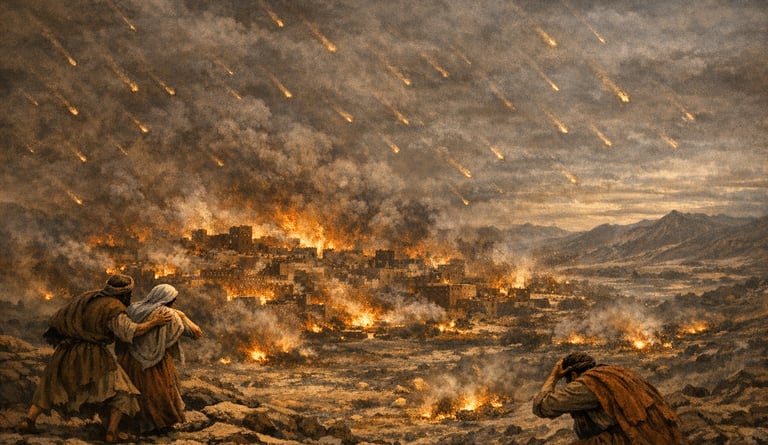
Elemental sulfur nodules can fall from the sky, but not because they form in clouds. Instead, they appear when a catastrophic ground‑level event blasts sulfur into the atmosphere, where it cools, condenses, and returns to earth as “sulfur rain.” Volcanic or geothermal eruptions can release enormous amounts of hydrogen sulfide and sulfur dioxide, which oxidize in the air and condense into elemental sulfur droplets. These droplets clump into small nodules and fall back to the ground, producing yellowish particles, strong sulfur odors, eye irritation, and fires where hot fragments land. This phenomenon aligns closely with ancient descriptions of brimstone.¹
Sulfur can also be lofted into the air through the combustion of sulfur‑rich materials such as bitumen, petroleum, and asphalt. In regions like the Dead Sea basin, where these materials are abundant, ignition from lightning, earthquakes, or explosive events can vaporize sulfur-bearing deposits. As the vapors cool, they condense into droplets that fall as hot sulfur pellets, creating a natural analog to “fire and brimstone raining from heaven.”² High‑energy meteoric airbursts can produce similar effects by igniting surface hydrocarbons, vaporizing sulfur-rich sediments, and blasting sulfur aerosols high into the atmosphere. As the plume cools, sulfur returns to the ground as pellets, nodules, powder, or burning fragments.³ Even localized explosions in sulfur-rich environments can eject sulfur chunks, sulfur-coated ash, and sulfur-laden dust that fall mixed with soot and debris, much like the “black rain” observed in modern oil‑field fires.⁴
Given the purity of the sulfur nodules found in certain ash-like formations, the most plausible explanation is that a high‑heat event vaporized sulfur-bearing material, which then condensed in the air and fell as pellets. This is consistent with geothermal activity, hydrocarbon ignition, shockwave events, or a chain reaction involving burning bitumen and sulfur. To ancient observers, the result would have appeared exactly as described in Genesis 19: flaming debris falling from the sky, burning sulfur striking the ground, ash clouds darkening the atmosphere, heat‑altered terrain, and sulfur nodules embedded in the destruction layer.
In the ancient world, “brimstone” referred to elemental sulfur, especially when burning. Sulfur burns with a blue flame, produces toxic and corrosive sulfur dioxide gas, melts into sticky burning droplets, and readily ignites organic material. These properties explain why ancient cultures associated sulfur with purification, judgment, and total destruction.⁵ If sulfur nodules or sulfur-rich debris fell onto a city, destruction would come through direct combustion, toxic gas release, and heat‑altered terrain. Burning sulfur would ignite structures, spread fire, and generate intense localized heat. The resulting sulfur dioxide would irritate lungs and eyes, drive people and animals away, and corrode building materials, rendering the area uninhabitable. High‑heat events involving bitumen or hydrocarbons could leave the ground ash-like, brittle, chemically altered, and coated in sulfur deposits—conditions that match the friable terrain seen in sulfur-nodule sites.
The long-term consequences for life and civilization would be severe. Sulfur dioxide and sulfuric compounds acidify soil, kill microorganisms, destroy plant roots, and prevent regrowth for years or decades, leaving the land barren. Water sources would become contaminated as sulfur dioxide dissolves into sulfurous acid, making water undrinkable, killing aquatic life, and corroding storage systems.⁶ With no crops, no grazing land, toxic air, and contaminated water, agriculture and livestock would collapse, forcing abandonment of the region. Such an area could remain deserted, chemically hostile, and culturally avoided for generations, mirroring the long-term desolation associated with the southern Dead Sea basin.⁷
Sulfur also creates atmospheric darkness through several mechanisms. When sulfur burns, it releases sulfur dioxide, which oxidizes into sulfate aerosols that scatter and absorb sunlight, producing hazy skies, reduced visibility, and surface cooling. This is the same process behind historical dimming events such as Tambora’s “Year Without a Summer” and the Pinatubo eruption.⁸ When sulfur mixes with ash, soot, and charred organic particles during volcanic, meteoric, or combustion events, the resulting plumes can block sunlight, turn daylight orange or red, and create choking haze—imagery echoed in biblical descriptions of darkness. Burning sulfur itself produces dense, opaque smoke that spreads horizontally, hangs low, and obscures the sun.⁹ If sulfur-bearing ground material is vaporized by a meteor airburst, explosion, or volcanic blast, sulfur aerosols can be injected into the stratosphere, where they spread globally, persist for months or years, and dim sunlight on a worldwide scale.¹⁰ Additional chemical reactions between sulfur, water vapor, nitrogen oxides, and organic compounds can create sulfuric acid droplets and secondary aerosols that further scatter light and mute the sun’s brightness, producing the yellow, orange, or red sun described in apocalyptic imagery.¹¹
Conclusion:
Ok, so it’s the human talking again here. As a short conclusion here as I understand it: brimstone raining down from the sky can be explained by sulfur gases from volcanoes or other ground areas that might have them. If those places are struck by lightning, it could release those gases into the sky, and then rain down burning sulfur pellets (just imagine: fire rain). And so, the phrase “fire and brimstone” could be understood in this way for anywhere in the Bible where the interpretation is applied literally. In a more conceptual sense, fire means to consume—to burn up, and brimstone means to utterly decimate so that life is not livable anymore. This article also presents another option here for why in the day of judgement to come, the sun will be darkened and the moon will not give its light / it will appear red. It could be gases in the atmosphere as a result of sulfur. But what will set off this event? A volcano? A meteor? Worldwide thunderstorms? Or, an earthquake? Revelation 6:12 does tell us there will be a great earthquake before the sun goes dark, so maybe this is what really happens…
References
¹ Smithsonian Global Volcanism Program – Volcanic Gas
https://volcano.si.edu/volcanicgas.cfm (volcano.si.edu in Bing)
² Hatcher, P. – Geochemistry of Dead Sea Bitumen
https://doi.org/10.1016/0016-7037(88)90128-5 (doi.org in Bing)
³ Boslough, M. & Crawford, D. – Low-altitude Airbursts and Impact Damage
https://doi.org/10.1130/G24942A.1
⁴ National Institute for Occupational Safety and Health – Oil Fire Emissions
https://www.cdc.gov/niosh/topics/oilspillresponse (cdc.gov in Bing)
⁵ EPA – Sulfur Dioxide Basics
https://www.epa.gov/so2-pollution/sulfur-dioxide-basics (epa.gov in Bing)
⁶ Seinfeld, J. & Pandis, S. – Atmospheric Chemistry and Physics
https://doi.org/10.1002/9781118945568 (doi.org in Bing)
⁷ Frumkin, A. – Geology and Climate of the Dead Sea Basin
https://doi.org/10.1007/978-90-481-2770-0 (doi.org in Bing)
⁸ Robock, A. – Volcanic Eruptions and Climate
https://doi.org/10.1029/1999RG900008 (doi.org in Bing)
⁹ USGS – Volcanic Smog (Vog)
https://www.usgs.gov/programs/VHP/volcanic-smog-vog (usgs.gov in Bing)
¹⁰ Oman, L. et al. – High-latitude Eruptions and Climate Response
https://doi.org/10.1029/2005JD006286 (doi.org in Bing)
¹¹ Thordarson, T. & Self, S. – Atmospheric Effects of the Laki Eruption
https://doi.org/10.1029/2001JD002042 (doi.org in Bing)
Post 2 (science info from Copilot)
Why Burning Sulfur Survives Torrential Rain
Ezekiel 38:22 describes a moment where torrential rain, hail, fire, and burning sulfur all fall together. At first glance, this seems contradictory — water should extinguish fire. But sulfur behaves very differently from ordinary fuels, and once you understand its physical properties, the scene becomes not only plausible but scientifically coherent.
The first key is temperature. Elemental sulfur burns at 360–450°C (680–840°F), far hotter than most natural fuels. When cold rain strikes something burning at that temperature, the droplets flash instantly into steam, forming a thin vapor barrier that actually insulates the burning material beneath it.¹ Instead of extinguishing the fire, the water becomes part of a violent thermal exchange. This is the same reason lava and molten metal continue burning even during heavy storms.²
The second key is that sulfur melts once ignited. It becomes a thick, sticky, glowing liquid that clings to surfaces. Water cannot easily penetrate or disperse this molten layer. Even when rain hits it directly, the outer surface may cool or crust slightly, but the interior remains hot and continues burning. Industrial safety literature notes that molten sulfur fires are “notoriously difficult to extinguish with water” because the fuel simply re‑melts and re‑ignites beneath the surface.³
The third key is the gas layer produced by the fire itself. As sulfur burns, it releases sulfur dioxide, a hot, reactive gas that supports continued combustion. Even if the surface of the liquid sulfur is momentarily cooled by rain, the gas above it can remain ignited. Flames can hover just above the molten material, sustained by the chemical reaction rather than the surface temperature alone. This is why sulfur fires often require smothering agents rather than water to put them out.⁴
When you combine these three properties — extreme heat, molten persistence, and self‑sustaining combustion — the picture in Ezekiel becomes vivid and physically grounded. Imagine a storm so violent that hailstones hammer the ground while sheets of rain pour from the sky. Yet through the darkness, streaks of burning sulfur fall and continue to burn on impact, clinging to surfaces, glowing through the downpour, and refusing to be quenched. To an ancient observer, this would look like fire that defies the storm itself — a sign of judgment that overrides the natural order.
Far from being contradictory, the coexistence of rain, hail, fire, and brimstone reflects the real behavior of sulfur under extreme conditions. Ezekiel’s imagery captures a moment where natural forces converge in a way that feels supernatural in its intensity.
References
U.S. Geological Survey. Sulfur, Fire, and Volcanic Processes. Washington, DC: USGS, 1997. https://pubs.usgs.gov/publications (pubs.usgs.gov in Bing)
Oppenheimer, Clive. Volcanic Degassing. London: Geological Society Special Publications, 2003. https://www.geolsoc.org.uk/publications (geolsoc.org.uk in Bing)
National Institute for Occupational Safety and Health. Sulfur Fire Safety Guidelines. Washington, DC: NIOSH, 2016. https://www.cdc.gov/niosh
Environmental Protection Agency. Sulfur Dioxide: Health and Environmental Impacts. Washington, DC: EPA, 1999. https://www.epa.gov/so2-pollution (epa.gov in Bing)