
Revelation Decoder: Fire and Brimstone
This article is a word study of brimstone (mostly Old Testament) to come up with a working definition that may help explain the meaning of judgement. It also unlocks another puzzle piece for the book of Revelation.
ESCHATOLOGY
3/22/202610 min read
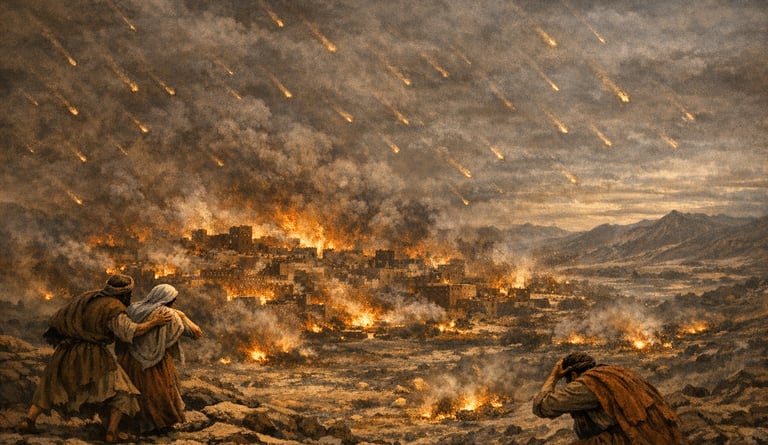
In this article, we will review all the occurrences of the word “brimstone” in the Old and New Testaments. The purpose is to develop a biblical background language model to understand this concept to apply correct biblical interpretation to the passages in the book of Revelation. If you have not seen my previous article on the science of brimstone, you can do so > here <
Note: this is not a preachy “brimstone and fire message.” This is a search for the truth.
Brimstone Info
From Zondervan’s Pictorial Bible Dictionary:
Brimstone, properly, sulphur. The Hebrew word is related to “gopher,” a resinous wood which was used in the construction of the ark; and so its root meaning is “resinous” or “highly combustible.” … In Revelation 9:17, “fire, jacinth, brimstone” refer to colors – red, blue, yellow.
From Nelson’s New Illustrated Bible Dictionary:
Brimstone. A bright yellow mineral usually found near active volcanoes. Large deposits of this substance are found in the Dead Sea region. Highly combustible, it burns with a very disagreeable odor. The Hebrew and Greek words for “brimstone” denote divine fire (Gen. 19:24; Ezek. 38:22; Luke 17:29). Brimstone (burning stone) is often associated with fire (Rev. 9:17-18; 20:10; 21:8), and with barrenness and devastation (Deut. 29:23; Job 18:15).
Brimstone without Fire in the Old Testament
Deuteronomy 29:23 speaks about a hypothetical future if Israel fails to obey the Lord, that a foreigner who looks upon the land of Israel will say of it, “All its land is brimstone and salt, a burning waste, unsown and unproductive, and no grass grows in it, like the overthrow of Sodom and Gomorrah, Admah and Zeboiim, which the Lord overthrew in His anger and in His wrath.” This verse demonstrates the enduring quality of fire and brimstone, that the land continues to be unfruitful and barren because the life has been choked out of it. We also see that the land is described as brimstone, meaning, the sulfur or the ecological damage that the sulfur caused to that land still resides in that land so that nothing grows in it. Fire and brimstone cause the initial damage, while the brimstone alone continues to keep it that way—destroyed, and consuming any life that might want to grow in it. In this way, to say that a land is “brimstone and salt” is to say that that the land is cursed and unlivable, regardless of whether the sulfur and salt are literally there or not.
In Job 18:15, Bildad uses the word brimstone to metaphorically describe the life of a wicked person, of someone who does not know God. He says, “There dwells in his tent nothing of his; brimstone is scattered on his habitation.” In other words, those who turn from God are as if they possess nothing, and the very little that they do have is taken away because its life is sucked out from beneath.
Fire and Brimstone in the Old Testament
Genesis 19:24-25 “Then the Lord rained on Sodom and Gomorrah brimstone and fire from the Lord out of heaven, and He overthrew those cities, and all the valley, and all the inhabitants of the cities, and what grew on the ground.” After its destruction, Abraham “looked down toward Sodom and Gomorrah, and toward all the land of the valley, and he saw, and behold, the smoke of the land ascended like the smoke of a furnace” (v. 28).
In Psalm 11:6, David speaks poetically, “Upon the wicked He will rain snares; Fire and brimstone and burning wind will be the portion of their cup.” Burning wind could be a heatwave, hot gases from a volcano, a sandstorm, or the feeling of the air during an event like the destruction of Sodom, where the fire made everything hot. This verse is symbolic because a bird trap or animal trap (snares) never rains from the sky. In this way, the phrase “fire and brimstone” is symbolically communicating divine retribution. The phrase has become synonymous with the event of Sodom and Gomorrah. The “portion of their cup” simply indicates what people consume—what their lot in life is or should become. This sentiment is similarly echoed in Revelation 16:6 “for they poured out the blood of saints and prophets, and You have given them blood to drink. They deserve it.” In both verses, consuming divine retribution is in mind.
In Isaiah 30:33, Topheth is said to be ready. Topheth is a location in the Valley of Hinnon, a place south of Jersualem where child burning sacrifices often took place. This is where we later got the word “Hell” from. It says, “For Topheth has long been ready, Indeed, it has been prepared for the king. He [God] has made it deep and large, A pyre of fire with plenty of wood; The breath of the Lord, like a torrent of brimstone, sets it afire.” The imagery here is that there is a bunch of wood piled up ready for the king’s funeral to burn his body, and this has been ready for a long time; all it needs is God’s breath to set it ablaze. In this way, God’s breath is symbolically compared to “a torrent of brimstone.” Torrent means: valley, river, or stream. NLT words this as “fire from a volcano” (since a valley is below a volcano, and brimstone is also associated with a volcano. Lava flows down the mountain and into the valley to ignite the fire). An alternative image that may be in view here is a river flash flood event. This would communicate the unstoppable force and power of God’s judgement that cannot be escaped. Combined with brimstone, it’s like napalm fire that water will be unable to put out (unquenchable). What is being communicated here is that hell (divine retribution) is ready for the king. With God’s direction, the king will be consumed in judgement, as if from a fire-breathing dragon that has found him out. In short, brimstone in this verse means unquenchable fire, which conveys a complete burning down to the crisp.
Isaiah 34:8-10 says
For the Lord has a day of vengeance,
A year of recompense for the cause of Zion.
Its streams will be turned into pitch,
And its loose earth into brimstone,
And its land will become burning pitch.
It will not be quenched night or day;
Its smoke will go up forever.
From generation to generation it will be desolate;
None will pass through it forever and ever.
The imagery conveyed here is that what was once abundant—turns into scarcity. What was alive—now dead. It’s a reversal of life. The clean, clear, and drinkable stream water turns into black tar, which ruins everything it touches. It also consumes everything because both the pitch and brimstone will burn. Water becomes fire. Fertile land becomes barren and wasted. This desolation will continue until it is thoroughly complete. Pitch and brimstone cannot be put out with water (quenched), because they are not ordinary combustibles. Putting water on it will only make it more violent—like putting water on a grease fire. The point here is not an eternal fire, but a fire that will thoroughly accomplish what it has set out to do—to consume completely. Eventually, pitch and brimstone stop burning. The “forever and ever” is hyperbolic and only means “for a very long time.” We know that at the end of the age, God will create a new heaven and a new earth, and all things will be renewed and restored. This land that was once destroyed will become the inheritance of God’s people, and it will flourish. The smoke going up forever is also hyperbolic. The place that Isaiah speaks of being destroyed here is Edom, and it was destroyed, but it is not still burning to this day (v. 5-6). The outcome of the fire was permanent with lasting results of desolation. In short, the symbolic definition of the word “brimstone” in this verse means divine judgement and lasting desolation. The smoke rising forever means irreversible destruction upon Edom.
In Ezekiel 38:22 on the prophecy of Gog and the future invasion of Israel, it says, “With pestilence and with blood I will enter into judgment with him [Gog]; and I will rain on him and on his troops, and on the many peoples who are with him, a torrential rain, with hailstones, fire and brimstone.” God is warning about the destruction He will bring about on Gog (a nation/people group) in the last days. Torrential rain echoes back to the worldwide flood in Noah’s day. The hailstones echo back to the destruction of Egypt in Moses’ day. And the fire and brimstone echo back to the destruction of Sodom and Gomorrah in Abraham’s day. Three symbols of divine judgement together in the same sentence communicate the intensified fullness of God’s judgement, and His just verdict for bringing it about. In simplistic terms, it means God is going to destroy with water, pestilence, and fire. In symbolic terms, God will make sure the judgement will completely do what He has justly determined it should do.
Brimstone and Fire in the New Testament
Luke 17:29 says that in Sodom “it rained fire and brimstone from heaven and destroyed them all.” In the context of this verse, it is speaking of what the second coming of Christ will be like. First, the coming of the Son of Man was compared to the total destruction of the worldwide flood in Noah’s day. Then it is compared here to the destruction of Sodom, which was total destruction. And, in both instances, people were going about their normal days, while suddenly, judgement overtook them. Then in verses 34-35, it speaks about how there will be two people in one bed, and two people grinding flour at the same place, and two people in a field, “one will be taken and the other will be left.” Some interpret this as some kind of secret rapture, but that would be incorrect, because the context indicates to us that this is speaking of one person being taken in judgement and then the other person’s life being spared. Both are still on the earth, except one is dead and the other is still alive, provided that they follow the Lord’s instructions (unlike Lot’s wife and the people Noah preached to). Whether you believe in the rapture or not, or differ on the timing of the rapture, this text should not be used as a proof-text to support the rapture.
Brimstone passages to study in the book of Revelation: 9:17-18; 14:10; 19:20; 20:10; 21:8
I won’t get too deep into these passages because there is a lot to unpack and interpret. However, we are one piece of the puzzle closer to understanding a fuller picture. I will only mention a few short things here though.
The first observation I have is that in Revelation 9, fire and brimstone are mentioned along with smoke. In the passages we have just studied, smoke was not often in the same context, but especially not in the same sentence. However, being in the same context leads me to conclude that the smoke is a judgement itself, rather than just an effect of another judgement. It could be more than just a sign of destruction; it could be a toxic and gaseous plume of smoke. That would be a more literal understanding, while the symbolic understanding would be that it is painful to the senses/psychology as smoke gets in the eyes and irritates them, along with the lungs, causing one to choke, and makes breathing difficult. Therefore, the smoke could represent psychological torment. Maybe by demons??
The second observation, which I have mentioned previously on my website in the Afterlife Series, is that Revelation 14 is not speaking of an afterlife idea of Hell. It says:
If anyone worships the beast and his image, and receives a mark on his forehead or on his hand, he also will drink of the wine of the wrath of God, which is mixed in full strength in the cup of His anger; and he will be tormented with fire and brimstone in the presence of the holy angels and in the presence of the Lamb. And the smoke of their torment goes up forever and ever; they have no rest day and night, those who worship the beast and his image, and whoever receives the mark of his name. (Rev 14:9-11)
This is speaking about the destruction that will happen on the earth, while those people are on the earth, and so long as they worship the beast, they will be tormented (as they are still alive on the earth). How will they be tormented? By all the trumpets and bowls that are being poured out. We have already seen in the destruction of Edom that smoke going up forever is symbolic for utter destruction, not an indication of literal eternal torment. Additionally, it says that they will be tormented “in the presence of the holy angels and in the presence of the Lamb.” But what is the final final judgement? If God says “depart from Me” (Mt 7:23; 25:41) and that their punishment is “away from the presence of the Lord” (2 Thess 1:9), then how can they be at the same time in the presence of the Lamb? It’s a contradiction, is it not? Therefore, this passage in Revelation is not speaking about the afterlife/eternal judgement. Eternal separation from God does not equal—in the presence of God.
I have previously spoken about the lake of fire being a symbolic representation of “the second death” in previous articles. So, I will not get into that here. However, I would like to hone in on the phrase “fire and brimstone.” Synthesizing the definitions and symbolism we have learned from the Old Testament, what would be the most natural reading and understanding of this phrase?
The fire burns to destroy completely, where nothing, not even water can undo its destruction (because of the sulfur). And if the fire did not destroy everything, the brimstone that lingers on the land would make sure of it. It will leave the land absolutely desolate, uninhabitable, where no life can rise up. This means—double dead—fully unalive. Annihilation. That is why it is called “the second death” (Rev 21:8). Even if the fire keeps going, what is thrown in there won’t keep going. It will be consumed like trees, chaff, and branches (Mt 3:10-12; Jn 15:6). The language in Revelation about the lake of fire has some literal elements (as there will be judgements people will experience on the earth in the Day of the Lord, along with whatever afterlife punishment God may have for them). However, the language is mostly symbolic and hyperbolic, even as the use of language was in the Old Testament prophets.
Word Synthesis Conclusion
The phrase "fire and brimstone" should be understood as a cohesive unit. The fire is unquenchable because of the brimstone that burns. Symbolically, “brimstone” functions in Scripture as an image of divine judgment that destroys, sterilizes, and exposes. It can signify lingering desolation, as in Deuteronomy 29:23 where the land remains “brimstone and salt,” meaning life has been choked out and cannot return (the land continues to be unfruitful and barren because the life has been choked out of it). It can represent the emptiness and collapse of the wicked, as in Job 18:15 where “brimstone is scattered on his habitation,” portraying a life whose vitality has been drained away. In judgment scenes, brimstone symbolizes unquenchable, consuming fire—a force that burns until nothing remains, as in Isaiah 30:33 where God’s breath is “like a torrent of brimstone” that ignites the pyre, or Isaiah 34:8–10 where land becomes pitch and sulfur, a picture of irreversible devastation (what was once abundant—turns into scarcity). Finally, brimstone evokes total, decisive destruction in eschatological contexts such as Ezekiel 38:22 and Revelation, where fire and sulfur together communicate a judgment that is thorough, inescapable, and leaves behind only desolation.
Quotations taken from the New American Standard Bible 1995 (NASB1995) by the Lockman Foundation.